

In Kenya’s fast-growing economy, where SMEs contribute 40% of the GDP and Nairobi’s tech ecosystem is booming, Customer Relationship Management (CRM) systems are no longer optional.
Yet, 22% of sales professionals globally still lack clarity on what CRM entails, and Kenyan businesses face unique challenges in adoption, from mobile accessibility to local compliance.
The choice of a CRM system can significantly impact business operations, customer satisfaction, and revenue growth.
This comprehensive guide explores the CRM landscape specific to Kenya, offering data-driven insights and practical frameworks to guide your selection process while addressing the unique challenges and opportunities within the local market.
The digital transformation wave continues to reshape how Kenyan businesses manage customer relationships. While comprehensive CRM adoption statistics specific to Nairobi remain limited, clear patterns have emerged that reflect the unique characteristics of the local business environment.
**
The Rise of Mobile-First CRM Solution
**
**
- 61% of Kenyan CRM users access platforms via mobile devices, driven by 68.8 million mobile connections and 48% internet penetration (DataReportal).
- Businesses using mobile CRM in Kenya report 150% higher sales goal achievement compared to non-users (crm.org).
- Kenya's mobile-first market demands CRM solutions that perform seamlessly on smartphones and tablets.
**
AI and Hyper-Personalization
**
**
- 65% of Kenyan businesses now use AI-driven CRM tools for predictive analytics and chatbots, leading to a 15% increase in customer retention (Flowlu).
- Example: A Nairobi healthcare provider saw 27% higher patient retention after integrating AI-powered CRM for personalised follow-ups.
**
Industry-Specific Adoption
**
**
- Financial Services: Banks, microfinance institutions, and insurance companies are leveraging CRMs for customer onboarding, relationship management, and personalized service delivery.
- Real Estate: Property developers and agencies are using CRMs to manage leads, track property inquiries, and nurture client relationships.
- Retail and E-commerce: Businesses with online and offline presence are adopting CRMs for customer segmentation, targeted marketing, and improved customer service.
- Hospitality and Tourism: Hotels, tour operators, and travel agencies are utilizing CRMs for booking management, guest communication, and loyalty programs.
**
Communication Platform Preferences
**
**
- WhatsApp has emerged as a dominant business communication channel in Kenya, with many service-based businesses relying exclusively on this platform rather than traditional email for client interactions.
- This trend indicates that CRM solutions with robust WhatsApp integration capabilities are particularly valuable in the Kenyan market.
**
Integration with Local Payment Systems
**
**
- The payments landscape in Kenya continues to be dominated by mobile money solutions, with M-Pesa maintaining an extraordinary 96.5% market share as of 2023 (Techpoint).
- Recent developments, such as the integration between M-Pesa and PesaLink (which connects 39 banks nationwide), highlight the growing importance of interoperability within Kenya's financial ecosystem.
- For businesses selecting CRM systems, integration capabilities with these dominant payment platforms have become a critical evaluation criterion.
Implementing CRM systems in Kenya presents unique challenges that businesses must navigate to ensure successful adoption and return on investment.
**
Data Integrity and Migration
**
**
- 33% of Kenyan sales teams report incomplete or outdated CRM data, costing businesses up to 20% in lost revenue (Startups).
- Barclays Bank Kenya faced hurdles migrating legacy systems to a centralized CRM, citing duplicate records and integration instability (UONbi).
**
Platform Compatibility and Integration Issues
**
**
Many Kenyan businesses struggle to find CRM solutions that seamlessly integrate with locally popular communication platforms.**For instance, businesses that primarily communicate with clients via WhatsApp often find mainstream CRM solutions lacking in native WhatsApp integration capabilities.
This communication disconnect creates significant operational inefficiencies when customer conversations must be manually transferred between platforms.
**
Data Privacy and Security Concerns
**
**
Businesses handling sensitive customer information through messaging platforms like WhatsApp face legitimate concerns about data privacy.
This is particularly relevant when considering CRM platforms that interface with messaging applications, as illustrated by one business owner who questioned whether their WhatsApp communication would be readable by their CRM platform.
Such concerns necessitate clear understanding of how customer data is handled, stored, and protected by potential CRM vendors.
**
Limited Local Support and Expertise
**
**
The availability of local support for international CRM platforms remains inconsistent across Kenya.
Businesses frequently encounter challenges finding vendors with robust local presence, technical expertise, and understanding of Kenya-specific business processes and regulatory requirements.
**
Cost Structures Misaligned with Local Market
**
**
Many global CRM platforms utilize pricing models designed for Western markets that may not align with Kenyan business realities.
This mismatch often results in businesses paying for features they don't need while lacking critical functionality relevant to the local context.
-
Responsive Table Layout
Aspect
Key Details
Budget Considerations
Implementation and Ongoing Costs
- Assess both initial costs and recurring expenses.
- Watch for hidden costs (e.g., WhatsApp integration, compliance modules).
- Total cost of ownership may increase with additional features.
Value Beyond Price
- Focus on addressing specific pain points, not just subscription fees.
- For WhatsApp-heavy businesses, efficiency gains may justify higher upfront costs.
Local Compliance Requirements
Data Protection
- Ensure compliance with Kenya's data protection laws.
- Look for features like data localization, consent management, and transparent handling practices.
Industry-Specific Alignment
- Prioritize CRMs with audit trails, role-based access controls, and regulatory documentation for sectors like finance and healthcare.
Integration Capabilities
M-Pesa Integration
- Must support seamless M-Pesa integration for transaction tracking, reconciliation, and receipt generation.
Banking System Connectivity
- Prefer CRMs that bridge mobile money (e.g., M-Pesa) with banking systems like PesaLink for smooth financial operations.
WhatsApp Business Integration
- Look for real-time message sync, unanswered message filters, automated contact management, and consolidated communication history.
Mobile Accessibility Features
Responsive Design & Performance
- Ensure CRM interfaces are optimized for smaller screens and variable internet speeds.
Offline Capabilities
- Ideal CRMs should allow offline data access and synchronization when connectivity is restored—important for rural Kenyan businesses.
Vendor Reliability & Local Support
Local Presence Assessment
- Choose vendors with a strong footprint in Kenya or East Africa to ensure market-specific expertise and responsive support during Kenyan business hours.
Support Availability & Quality
- Verify live support availability during local hours.
- Check if support materials are tailored to Kenyan businesses.
- Assess vendor's implementation assistance quality.
For Kenyan businesses prioritizing WhatsApp integration, several specialized solutions have emerged to address this specific need:
OneHash Chat
-
WAPlus CRM
-
uchat and Intercom
-
Enterprise-Grade Solutions
This free tool offers WhatsApp business integration capabilities that may satisfy businesses primarily seeking to manage messaging-based customer interactions.
Its value proposition centres on simplifying WhatsApp business communication management without requiring investment in comprehensive CRM functionality.
Designed specifically as a WhatsApp CRM extension, WAPlus offers features directly addressing common pain points for Kenyan businesses, including the ability to filter message lists to identify unanswered communications, a capability frequently cited as crucial by service-based businesses.
These platforms represent additional options for businesses seeking specialised messaging management capabilities, though with potentially different feature sets and integration approaches that warrant careful evaluation against specific business requirements.
For larger organizations requiring more comprehensive CRM capabilities while maintaining local relevance, evaluation should focus on established platforms that have demonstrated commitment to the East African market.
CRM
Cost (Monthly)
M-Pesa Integration
Mobile Features
Local Support
Zoho CRM
14–52/user
Yes
Offline mode
Partner network
HubSpot
Free–$1,200
Custom API
Android/iOS app
Limited
Folk CRM
29–99/user
Native integration
USSD support
Nairobi office
Salesforce
25–300/user
Third-party plugins
Mobile analytics
Regional hub
Requirements Definition **
- Identify primary communication channels with customers (WhatsApp, email, etc.)
- Document current payment processing methods (M-Pesa, bank transfers, etc.)
- Establish non-negotiable integration requirements.
- Define mobile accessibility needs across your organization.
Vendor Evaluation
- Assess local presence and support capabilities.
- Verify WhatsApp and M-Pesa integration functionality.
- Evaluate mobile app performance and features.
- Check customer references specifically from Kenyan businesses.
- Review data security and privacy protection measures.
Implementation Planning
- Develop realistic timeline accounting for local constraints.
- Create data migration strategy for existing customer information.
- Design staff training program adapted to local knowledge base.
- Establish clear success metrics relevant to your business.
Post-Implementation Assessment
- Measure response time improvements for customer inquiries.
- Track reduction in missed customer communications.
- Monitor sales conversion rate changes.
- Evaluate customer retention improvements.
- Calculate ROI based on defined success metrics.
Selecting the right CRM for your Kenyan business requires balancing global best practices with local market realities.
The most successful implementations align technology choices with Kenya's unique business ecosystem, particularly regarding communication preferences and payment systems.
For personalized guidance on CRM selection and implementation tailored to your specific business challenges, consider engaging with local CRM implementation specialists who combine international best practices with deep understanding of Kenya's business landscape.
The right CRM partner can significantly accelerate your path to improved customer relationships, operational efficiency, and sustainable growth in Kenya's competitive marketplace.
Stay current with our insights
One monthly email. Banking, insurance, AI/ML and CRM field notes. No spam.
We respect your privacy. Read our Privacy Policy.
Keep reading
More from CRM
CRM
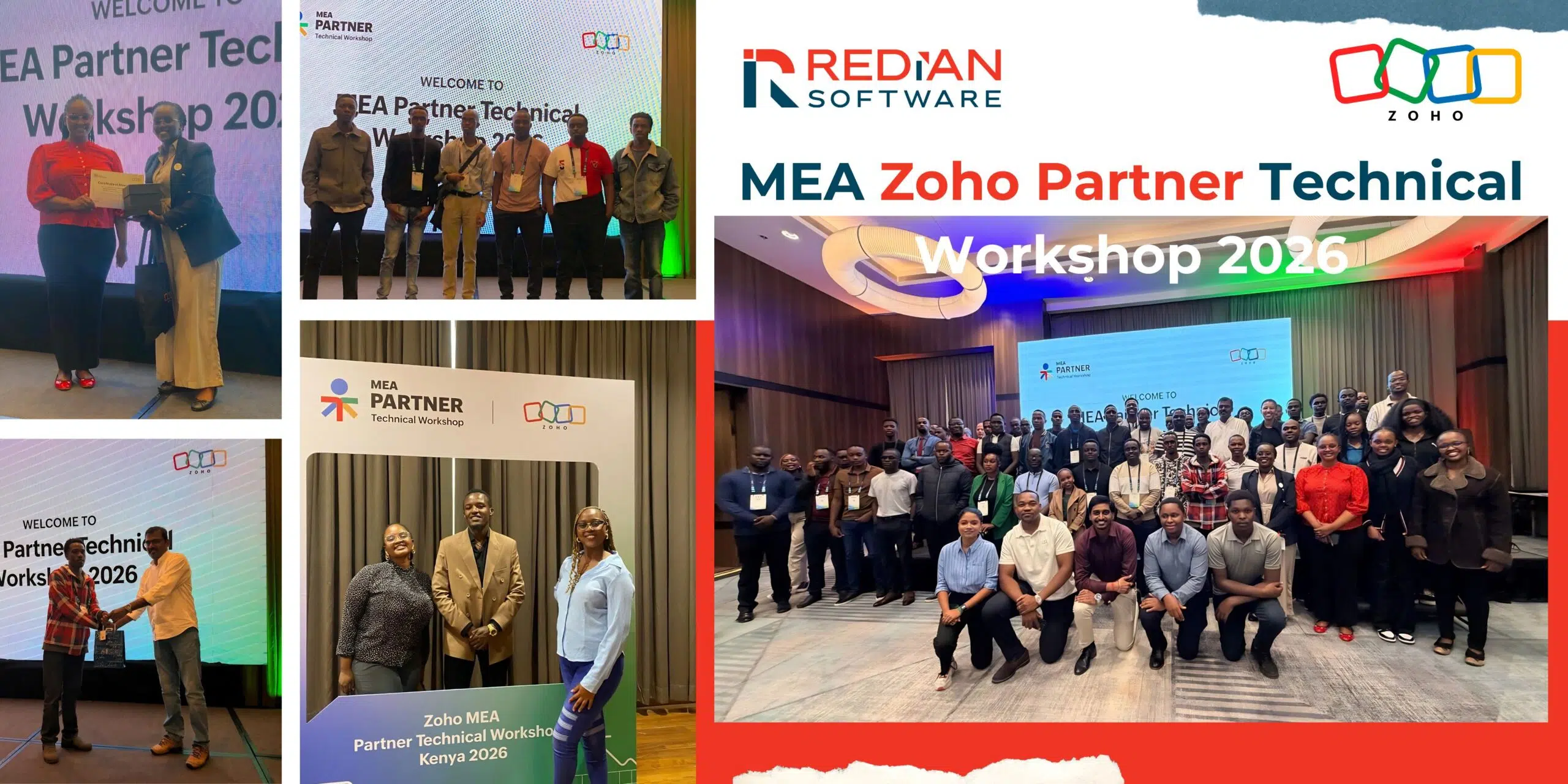
MEA Zoho Partner Technical Workshop 2026: 7 Game-Changing Takeaways
Discover 7 powerful insights from the MEA Zoho Partner Technical Workshop 2026 in Nairobi. Learn how Zia Agents, agentic automation, and Zoho RPA are transforming business operations across Africa. By Redian Software, Advanced Zoho Partner
19 May 2026

CRM
Data privacy in CRM — why SuiteCRM is ideal for regulated industries
For banks, insurers and fintechs, data sovereignty isn't optional. Why open-source SuiteCRM remains the right call for regulated CRM workloads.
06 Apr 2026
CRM
CRM vs custom software — Zoho, Odoo, SuiteCRM guide for SMEs
The 2026 decision tree for SME and mid-market: when to pick CRM platforms (Zoho, Odoo, SuiteCRM) and when to build custom software instead.
29 Jan 2026
Build with Redian
Have a similar build in mind?
We've shipped crm systems for banks, insurers, brokers, MFIs, SACCOs and enterprises across the USA, UK, Africa, UAE and India. Book a 30-min call with a senior engineer — no pitch deck, just a sharp first read on your initiative.
- CMMI Level 3 Appraised · ISO Certified delivery
- 1 business day response · NDA on request
- Senior engineers, not sales — first call