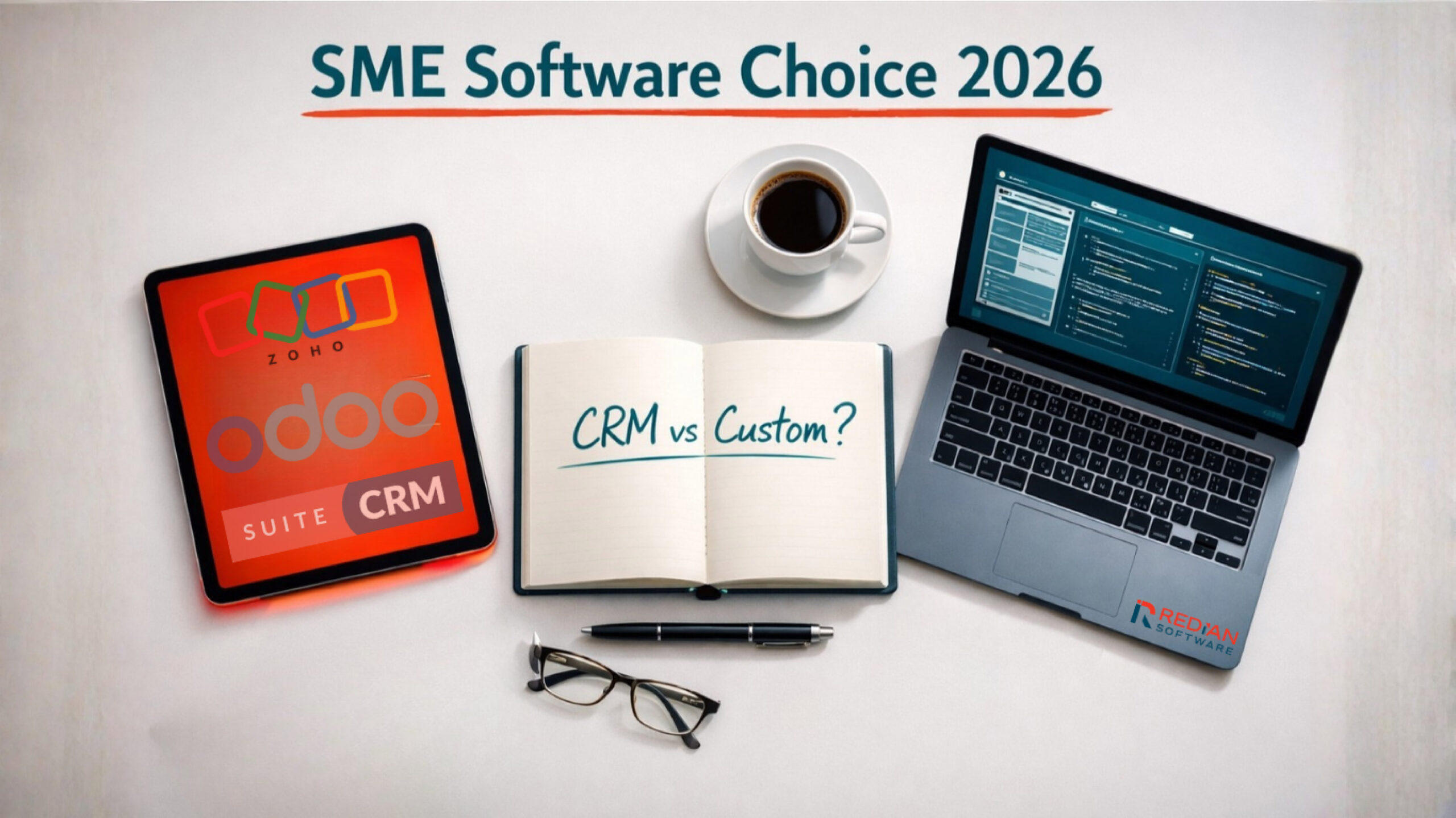
The wrong question kills budgets
Most SME and mid-market buyers walk into this decision asking "should we build or buy?" That framing is wrong, and it's why so many CRM and ERP rollouts either over-spend on bespoke code or strangle a differentiated business inside a generic platform. The right question is sharper: which 80% of our workflow looks like every other company in our category, and where is the 20% that actually makes us money? The 80% belongs on a CRM or ERP platform. The 20% is where custom code earns its keep — and nowhere else.
Get the split right and you launch in a quarter, not a year. Get it wrong and you either pay licence fees forever for software that doesn't fit, or you reinvent quote-to-cash from scratch because someone said "we're different." You're not that different. But you are different somewhere, and finding that somewhere is the entire job of the architecture conversation.
When Zoho, Odoo or SuiteCRM is the right answer
A CRM or ERP platform is the right call when your core revenue and operations processes are recognisable to anyone in your industry. Leads come in, salespeople qualify, quotes go out, deals close, finance invoices, support handles tickets. If that describes 80% or more of your daily reality, you do not need a custom application. You need a configured platform, clean data, and a team that will actually use it.
Pick a platform first when:
- Your sales, marketing, service and back-office processes look broadly like industry standard for SMEs in your sector
- You need to be live in 8–12 weeks, not 8–12 months — because the cost of not having a system is already hurting you
- You want predictable per-user subscription pricing instead of a large capex hit followed by ongoing maintenance liabilities
- Your team can invest in adoption — because most CRM failures are cultural, not technical, and no amount of customisation rescues a team that won't log in
For most SMEs, Zoho One gets you a unified suite — CRM, Books, Desk, Campaigns, People — at a price point that's hard to beat. For product-led businesses that need inventory, manufacturing or field service alongside CRM, Odoo is usually the better fit because the modules genuinely talk to each other out of the box. For organisations that want full ownership of the data, source code and roadmap, SuiteCRM — or a managed hosted SuiteCRM deployment — gives you an open-source foundation without the per-user tax.
The platform choice matters less than people think. The configuration, data model and adoption plan matter far more.
When custom software actually wins
There are situations where a platform will fight you forever, and the honest recommendation is to build. We make this call against our own services revenue more often than you'd expect, because forcing the wrong tool is how we lose clients.
Custom software is the right answer when:
- Your differentiating process is the business model — marketplaces, two-sided platforms, embedded finance, claims engines, pricing algorithms
- You operate at a scale where per-user CRM pricing dwarfs the cost of building and maintaining your own application
- You need true data sovereignty, on-premise hosting, or deep integration with a regulator that no SaaS vendor will accommodate
- Your competitive moat is the workflow itself, and exposing it to a third-party platform creates lock-in or IP risk
- The compliance regime — banking, insurance, healthcare — demands controls that off-the-shelf platforms can't evidence
A core banking system, an insurance policy administration platform, an ML-driven pricing engine, a broker management system serving hundreds of intermediaries — none of these belong inside a generic CRM. They are the business. We've built each of them for clients across Africa, the UK and the Middle East, and in every case the cost of not building was significantly higher than the cost of building well. Our work on BFSI solutions is built around exactly this principle.
The hybrid path most mid-market companies should take
The single most under-rated answer in this market is: both. Most successful mid-market deployments we run are hybrids. A CRM platform handles the 80% — accounts, contacts, opportunities, quotes, invoices, helpdesk, HR, expenses. Custom code handles the 20% that's actually differentiating, integrated via APIs and webhooks so the two halves behave like one system.
This pattern minimises three things at once: upfront capital, ongoing licence creep, and long-term lock-in. It also lets you sequence the work. Get the platform live in a quarter, get the team using it, then invest in custom modules where the data already exists and the integration patterns are proven.
We've used this hybrid model for an investment bank that wanted SuiteCRM for KYC and onboarding alongside custom compliance tooling. We've used it for a mortgage and finance group on Zoho CRM with bespoke underwriting workflows bolted on. We've used it for a Kenyan insurance aggregator where the consumer-facing platform was custom but the back office ran on packaged tools. The pattern travels.
A three-step decision framework
You don't need a six-month consulting engagement to make this call. You need a list and a marker pen.
- Map your top 30 workflows. Not 300 — the ones that touch revenue, customer experience, compliance or cost daily. Be concrete: "salesperson sends a renewal quote," not "we do sales."
- Tag each one. Standard (every company in our sector does this the same way), Configurable (mostly standard but with a few sector-specific quirks), or Differentiating (this is genuinely how we win or how we're regulated).
- Count. If 25 or more sit in Standard or Configurable, you start with a platform and configure hard. The remaining differentiating workflows — usually three to five — become a scoped custom build, integrated with the platform via API.
If the count flips the other way — more than half your top-30 is genuinely differentiating — you're probably a platform business, not a platform buyer. Skip CRM-first and go straight to a custom product development engagement.
Three traps that wreck CRM projects
After a decade of running these implementations, the failure modes are predictable.
Customising the platform until it isn't one
Every time you write a deluge script, a custom function or a bespoke layout, you're trading speed-to-launch for upgrade pain. Some customisation is healthy. A platform with 400 custom rules is a custom application with a vendor's logo and a licence bill — the worst of both worlds.
Building when you should have configured
Engineering teams over-estimate uniqueness. Sales teams over-estimate process complexity. "We're different" is true in maybe 20% of cases. The other 80% of the time it's a configuration exercise dressed up as a build.
Treating adoption as someone else's problem
The technical migration is the easy part. The hard part is sales managers who still keep their pipeline in a spreadsheet, or branch staff who paper-around the new system because nobody trained them. Budget for change management. It's the cheapest part of the project and the highest-leverage.
Cost reality check
A reasonable mental model for SME and mid-market budgeting:
- A configured Zoho or Odoo deployment for 25–100 users typically lands in the eight to twelve weeks range and a five-figure implementation budget, plus per-user subscriptions
- A custom application replacing core revenue workflows starts at a six-figure investment and a six to nine month delivery window
- A hybrid programme — platform plus two or three custom modules — usually delivers the platform phase in a quarter and the custom phase in the two quarters that follow
Numbers move with scope, geography and integration count. The shape rarely changes. If a vendor promises a custom enterprise platform in six weeks, or a CRM rollout in two, ask harder questions.
How we make this call with clients
Our diagnostic is deliberately boring. A short workshop to map workflows and score them. A platform recommendation that's vendor-agnostic because we sit across Zoho, Odoo, SuiteCRM and Salesforce — we have no incentive to push the wrong one. A custom-build scope only for the workflows that genuinely need it. A delivery plan that puts the platform live first and treats custom modules as a follow-on programme, not a big-bang launch.
Where regulation, data residency or scale make hosting a question in itself, we run the platform on infrastructure you control — including hosted SuiteCRM for clients in BFSI and regulated sectors who need open-source freedom without managing the stack themselves.
Build with Redian
We've been an Advanced Zoho Partner since 2017, an Odoo Official Partner, and a SuiteCRM specialist across 200+ implementations in the USA, UK, Africa, UAE and India. We also build custom software for clients whose differentiation refuses to fit in a platform. Either way, the recommendation is honest, the scoping is concrete, and the delivery is measured in shipped outcomes rather than slideware. If you'd like a vendor-agnostic read on your own workflow split, start a conversation with us.
Stay current with our insights
One monthly email. Banking, insurance, AI/ML and CRM field notes. No spam.
We respect your privacy. Read our Privacy Policy.
Keep reading
More from CRM
CRM
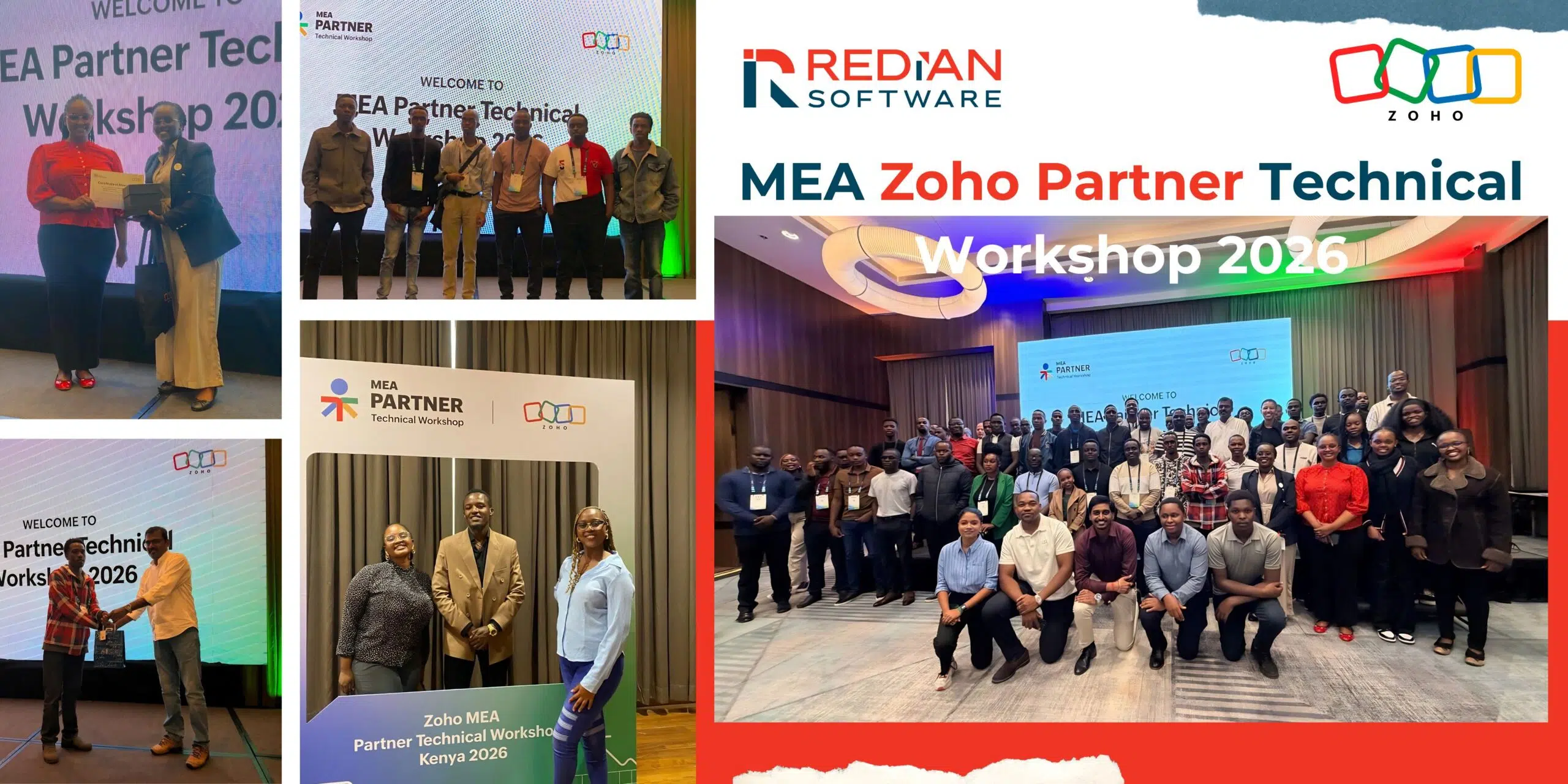
MEA Zoho Partner Technical Workshop 2026: 7 Game-Changing Takeaways
Discover 7 powerful insights from the MEA Zoho Partner Technical Workshop 2026 in Nairobi. Learn how Zia Agents, agentic automation, and Zoho RPA are transforming business operations across Africa. By Redian Software, Advanced Zoho Partner
19 May 2026

CRM
Data privacy in CRM — why SuiteCRM is ideal for regulated industries
For banks, insurers and fintechs, data sovereignty isn't optional. Why open-source SuiteCRM remains the right call for regulated CRM workloads.
06 Apr 2026
CRM
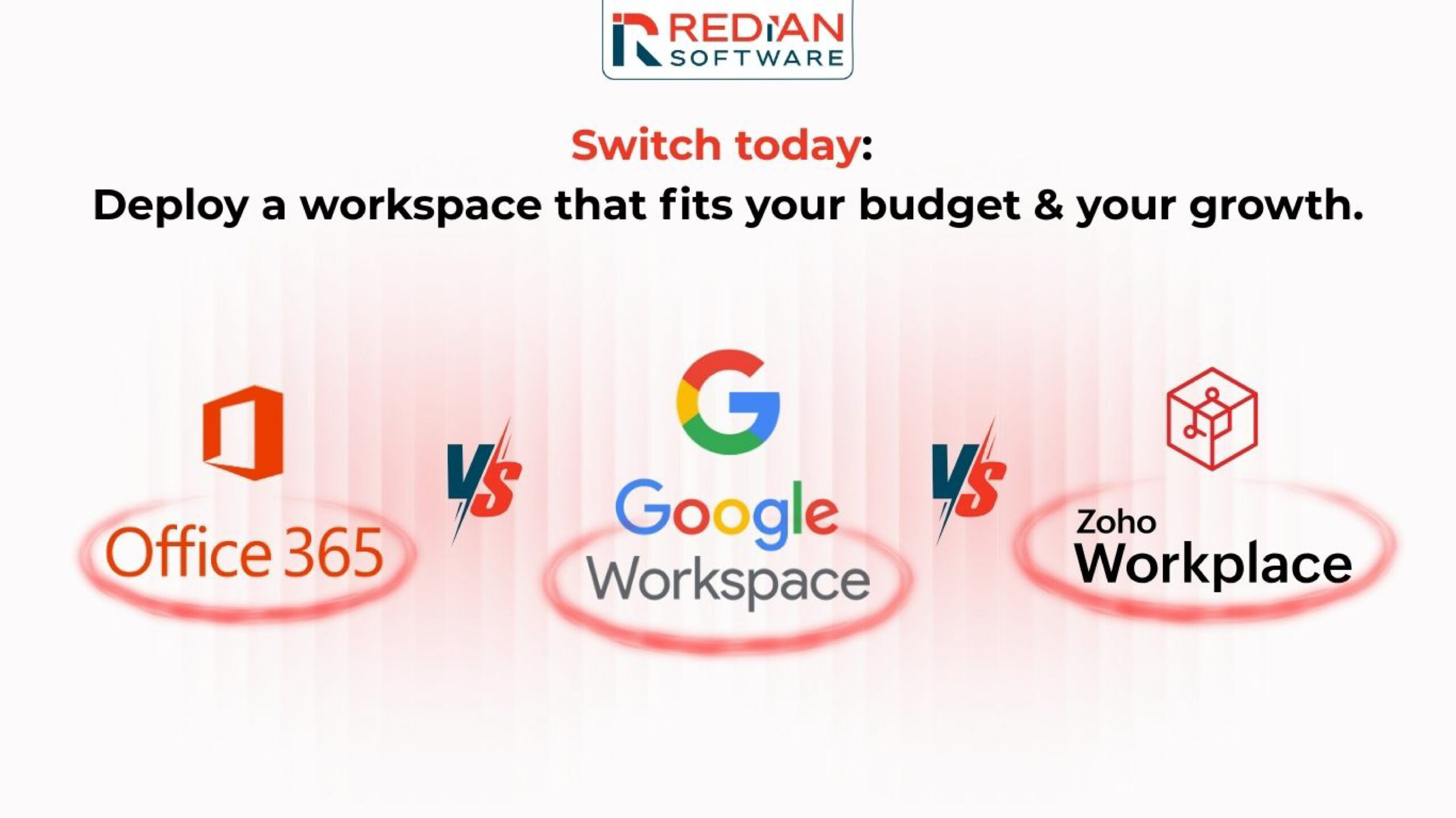
Office 365 vs Google Workspace vs Zoho — real cost for African businesses
The 2026 pricing analysis that vendor sales decks don't show: hidden fees, multi-currency complications and how African businesses can save 40–50% annually.
23 Jan 2026
Build with Redian
Have a similar build in mind?
We've shipped crm systems for banks, insurers, brokers, MFIs, SACCOs and enterprises across the USA, UK, Africa, UAE and India. Book a 30-min call with a senior engineer — no pitch deck, just a sharp first read on your initiative.
- CMMI Level 3 Appraised · ISO Certified delivery
- 1 business day response · NDA on request
- Senior engineers, not sales — first call