
Redian CEO joins NASSCOM country round tables at AI Impact Summit sidelines, New Delhi 2026
Field notes from the NASSCOM-organised country round tables held at the sidelines of the AI Impact Summit, New Delhi — what enterprises across India, Africa and the Middle East are actually buying, building and abandoning.
Enterprise boards are done funding AI pilots that never leave the lab. That was the loudest signal from the country round tables held at the sidelines of the AI Impact Summit in New Delhi — not from the keynote stage, but from the smaller rooms where buyers, regulators and exporters actually compare notes. The honeymoon with foundation models is ending; the budget conversation has started.
The setting
The AI Impact Summit drew more than 1,500 enterprise leaders, ministers and investors to New Delhi. Alongside the main programme, NASSCOM convened a series of country-focused round tables — small-format, closed-door conversations between Indian software exporters and senior buyers from priority markets including Africa, the Middle East and ASEAN.
Our CEO, Pavan Kumar Verma, attended several of these sessions on behalf of Redian Software. The format mattered: twelve to twenty people per room, Chatham House rules, real procurement conversations rather than pitch decks. The mandate from NASSCOM was simple — listen to what each market is actually buying, building and quietly walking away from.
What follows are field notes, not a press release. We have stripped out anything that would identify a specific bank, insurer or government department. The patterns, however, are worth sharing with our clients and partners.
Takeaway one: the foundation-model honeymoon is over
Across every country round table, the same shift was audible. Eighteen months ago, the brief was "try things with GPT". Today, the brief is "show me payback inside two quarters or kill the project". Boards have approved enough pilots. They now want production systems with measurable unit economics.
This is not AI scepticism. It is AI maturity. The CIOs in the room were not asking whether to use large language models — they were asking which workflows survive a hard cost-benefit review once you price in inference, observability, human review and the operational cost of being wrong.
A few concrete consequences we heard repeatedly:
- Procurement teams now ask for the dollar-per-transaction cost of an AI-assisted workflow, benchmarked against the manual baseline. Vendors who cannot answer that are being shortlisted out.
- Internal "innovation labs" are being folded back into core IT. The separation that made experimentation easy in 2024 is now blocking deployment.
- The bar for "good enough" has moved. A 92 percent accurate classifier that needs a human reviewer on every output is no longer interesting; the question is what you can ship at 99 percent with a sampled review.
For our own roadmap, this maps cleanly onto how we have been positioning AI/ML consulting and AI/ML development — pilots are fine as a wedge, but the engagement only matters if it lands in production with a unit economics model attached.
Takeaway two: document intelligence is the BFSI workhorse
If there was one use case that every BFSI buyer in the African and Middle Eastern round tables agreed was paying for itself, it was document intelligence. Not chatbots. Not generative marketing copy. Document intelligence — KYC packs, loan files, claims bundles, trade-finance paperwork, reinsurance slips.
The reason is obvious once you sit in the room. A mid-size bank in East Africa runs thousands of loan files a month through human reviewers who spend most of their time on data extraction, not credit judgement. An insurer in the Gulf handles claims packets that are 60 to 200 pages of mixed PDFs, photos and scanned forms. These are bounded, repetitive, high-volume workflows where a 70 percent reduction in handling time is both achievable and immediately visible on the P&L.
This is the territory we have been quietly building into for two years. Our core banking and loan management work increasingly ships with document intelligence built into the origination flow rather than bolted on afterwards. On the insurance side, the same pattern shows up in claims management and across policy administration — extraction first, then enrichment, then a model-assisted decision with a clear audit trail.
What the round table conversations confirmed is that buyers no longer want "an AI feature" inside their core platform. They want a measurable reduction in the cost-to-serve of a specific process, with the AI invisible to the end user. That is a meaningfully different sales conversation, and a meaningfully different way to build.
Takeaway three: data quality is back at the top of the agenda
The third pattern was the one nobody wanted to admit out loud at first, then everybody admitted at once: foundation models have exposed how bad enterprise data has always been.
Master data is duplicated. Customer records contradict each other across systems. Product taxonomies were last cleaned in 2017. Document repositories contain three versions of every policy, none of them marked canonical. For a decade, you could paper over this with rules and human judgement. The moment you point a language model at the same data, the contradictions become production incidents.
Several CIOs described the same arc — they started an AI project, the project surfaced the data problem, the AI project paused, and the next twelve months were spent on data engineering and governance. None of them regretted the detour. All of them wished they had started there.
For Redian, this is why our digital transformation and CRM/ERP implementation practices increasingly lead with a data audit before anyone talks about models. The interesting work in 2026 is not the model — it is the pipeline, the lineage, the deduplication and the access control that sits underneath it.
What buyers in Africa and the Middle East said specifically
The country-specific rooms had their own texture. A few notes worth recording without naming names.
In the East and West Africa sessions, regulators came up more than in any other room. Several central banks and insurance supervisors are drafting AI-use guidelines, and the buyers in the room were explicit that they will not deploy anything they cannot explain to a regulator. Explainability is not a nice-to-have in these markets — it is procurement criterion number one. This lines up with how we have built agency banking and reinsurance placement workflows for regional clients.
In the Middle East sessions, the conversation skewed towards sovereignty — data residency, in-country hosting, locally trained models. Buyers were comfortable with Indian engineering talent but firm about where the data lives and which clouds are acceptable. Our hybrid delivery from Dubai and Noida resonates here, and the GCC setup and IT staff augmentation discussions had a notably different shape from the African rooms — more about building local capability over twenty-four months than about buying a finished product.
ASEAN was the most price-sensitive room and the most open to fixed-scope, fixed-price engagements. Custom software with embedded AI features, rather than platform licences, was the preferred commercial structure.
What we are not changing
It is tempting after a summit like this to come home and rewrite the strategy. We did not. The round tables confirmed the direction we are already on — outcome-priced AI work, document intelligence as the BFSI wedge, data engineering as the unglamorous foundation underneath. What changed is the urgency. Buyers are ready to spend, but only against business cases they can defend internally.
A few things we are quietly tightening:
- Every new AI engagement now ships with a unit-economics model in the statement of work, not as a follow-on artefact.
- Our BFSI solutions team is standardising the document intelligence layer so that the same extraction and review pipeline serves banking, insurance and lending clients with minimal rework.
- The IT consulting practice is leaning harder into pre-engagement data audits, because the projects that fail are the ones that skipped this step.
Where the CEO actually speaks
A note on the format, since some readers have asked. The AI Impact Summit appearance was attendance-only at the NASSCOM-organised round tables — listening, not speaking. Redian's CEO speaks on the record at a different set of forums, including the TAG Conference in Zambia, the NASSCOM SME Conclave in Hyderabad, the NASSCOM National Technology Confluence in Jaipur, and the 3i Conference in Mauritius. We distinguish the two deliberately. Round tables are where we learn what the market is really doing; podiums are where we share what we have learned across our delivery hubs.
If you want the long version of the field notes, or a market-specific briefing for your own board, our leadership team is happy to set up a call.
Working with Redian
We came back from New Delhi with the same conviction we went in with — AI matters most when it is invisible inside a workflow that already pays the bills. If you are running a bank, an insurer or a broker in Africa, the Middle East or ASEAN and you want to talk about where document intelligence, data engineering and a measured AI roadmap fit into your next twelve months, get in touch. We will bring the field notes; you bring the P&L.
Stay current with our insights
One monthly email. Banking, insurance, AI/ML and CRM field notes. No spam.
We respect your privacy. Read our Privacy Policy.
Keep reading
More from News & Events
News & Events
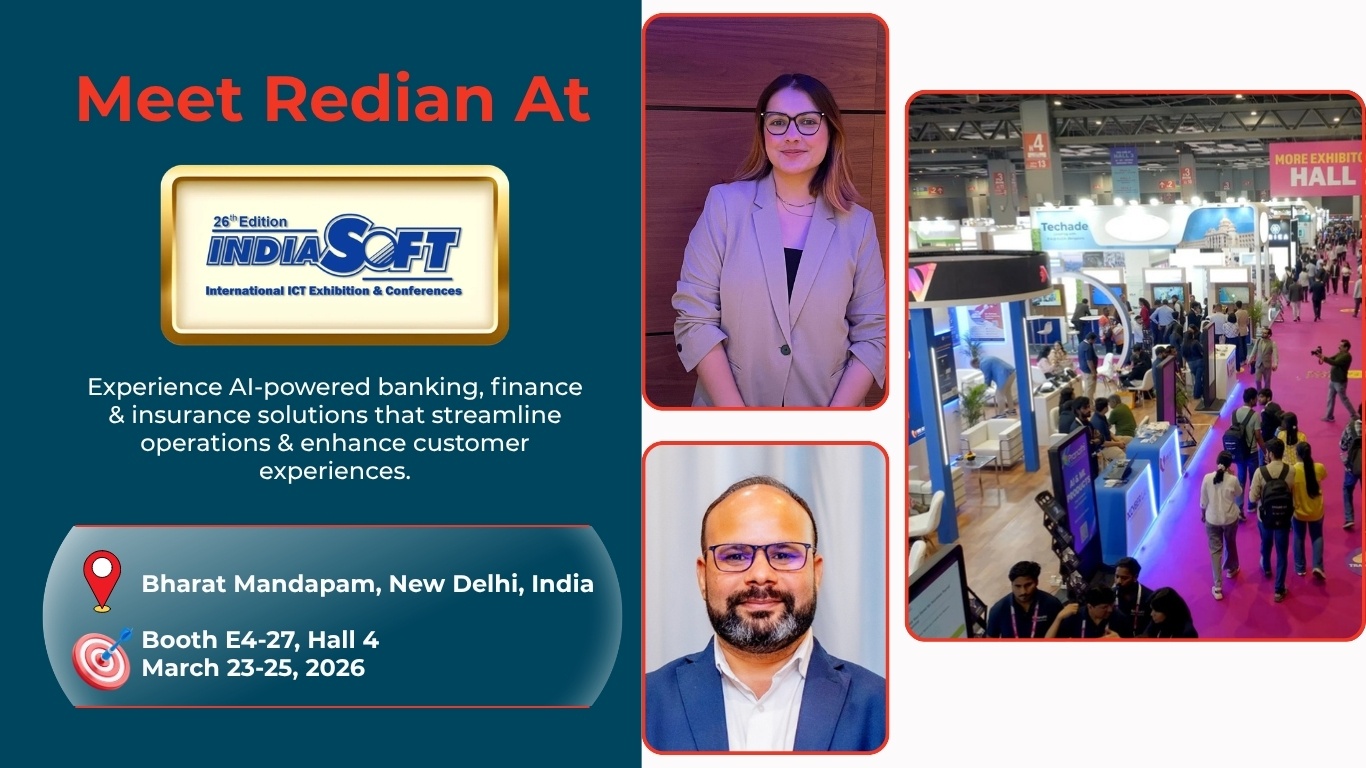
IndiaSoft 2026 — meet Redian Software at Booth E4-27
Redian Software will be at IndiaSoft 2026 (Bharat Tech) in New Delhi, showcasing custom software development and AI solutions. Book your meeting today.
22 Mar 2026
News & Events
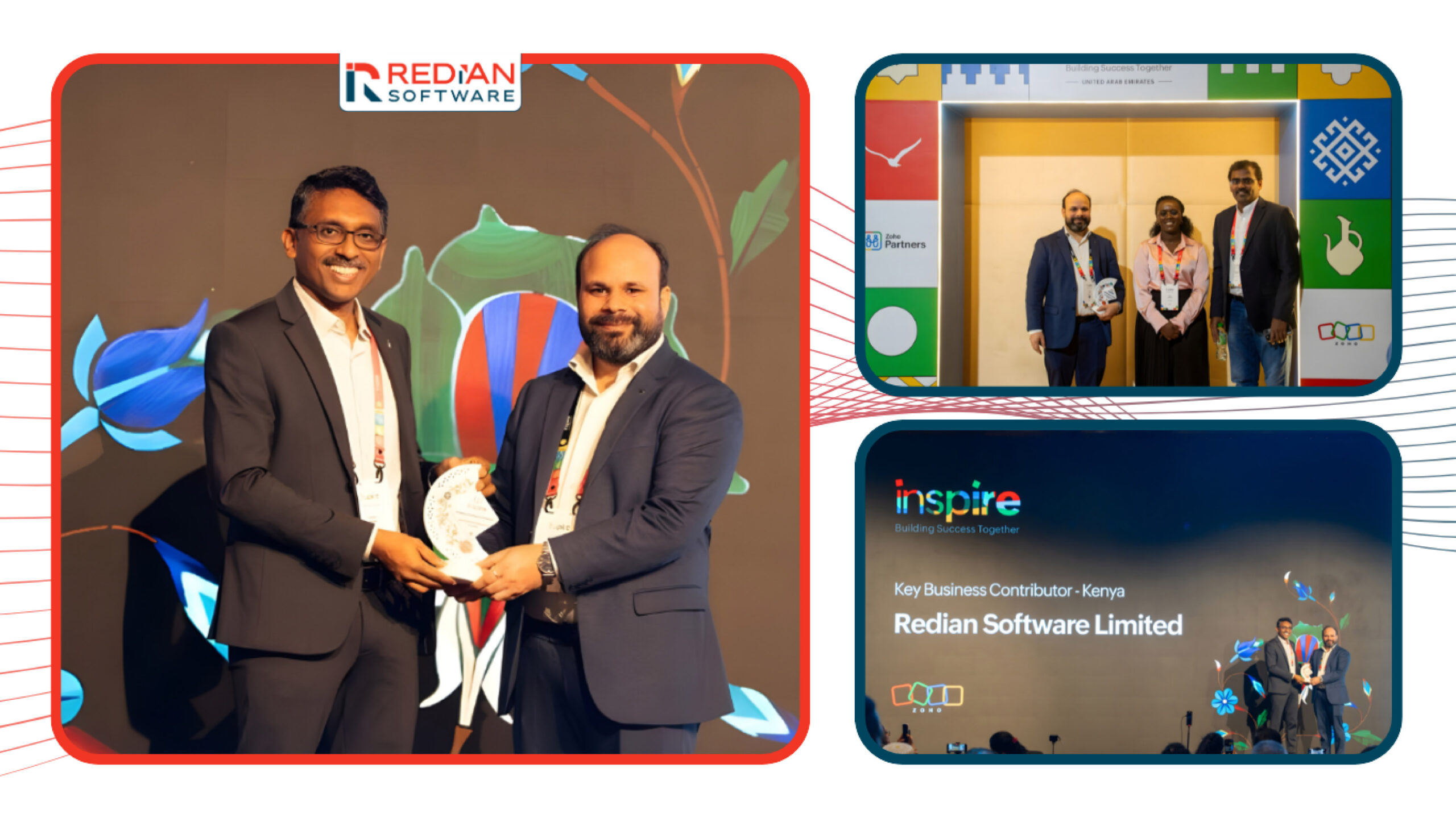
Zoho Key Business Contributor — Kenya 2026 award winner
Redian Software honoured as Zoho Key Business Contributor — Kenya 2026 at Zoho Inspire MEA in Dubai. Recognition for our East African Advanced Zoho Partner practice.
04 Feb 2026
News & Events
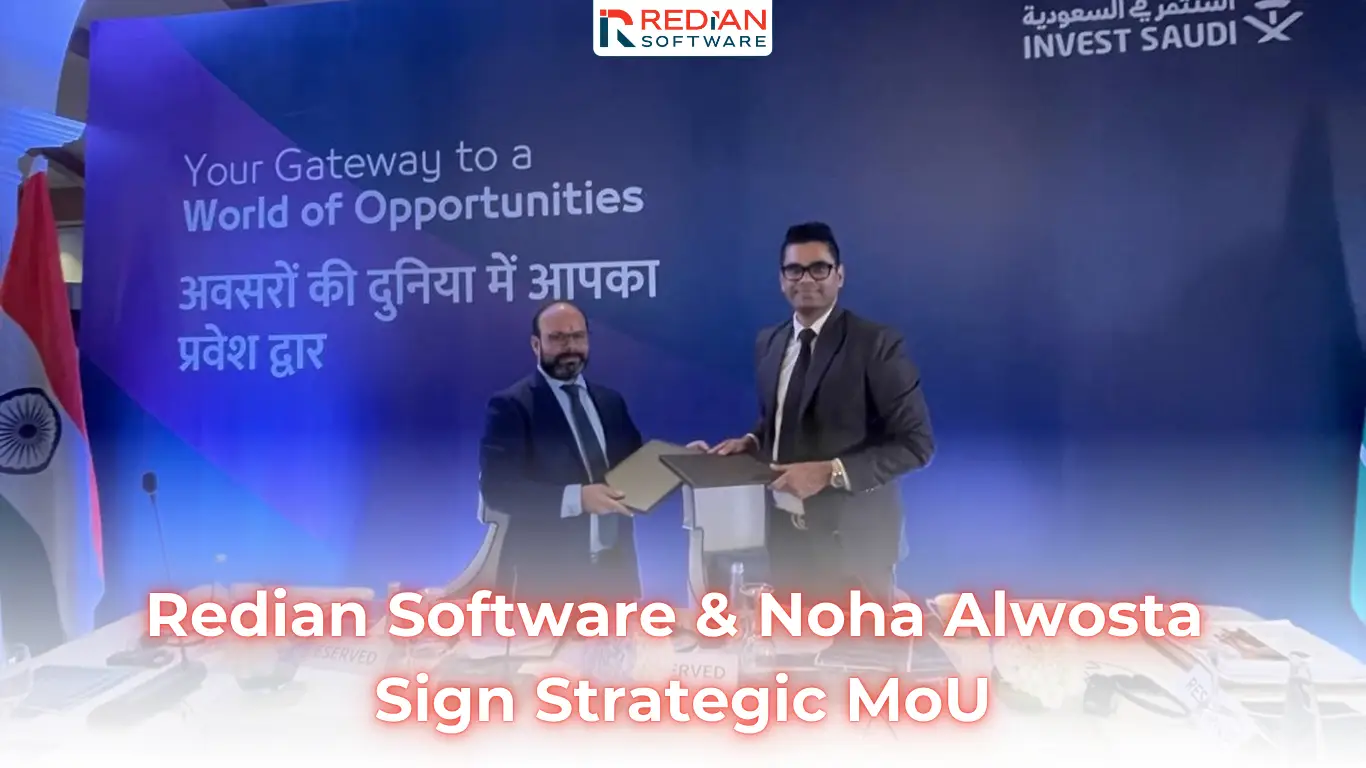
Redian Software & Noha Alwosta sign Strategic MoU | Saudi-India Tech Partnership
Redian Software signs strategic MoU with Noha Alwosta during Saudi delegation visit led by H.E. Minister Khalid Al-Falih. Explore Saudi-India digital transformation partnership advancing Vision 2030 & enterprise innovation. Read more.
19 Nov 2025
Build with Redian
Have a similar build in mind?
We've shipped news & events systems for banks, insurers, brokers, MFIs, SACCOs and enterprises across the USA, UK, Africa, UAE and India. Book a 30-min call with a senior engineer — no pitch deck, just a sharp first read on your initiative.
- CMMI Level 3 Appraised · ISO Certified delivery
- 1 business day response · NDA on request
- Senior engineers, not sales — first call