
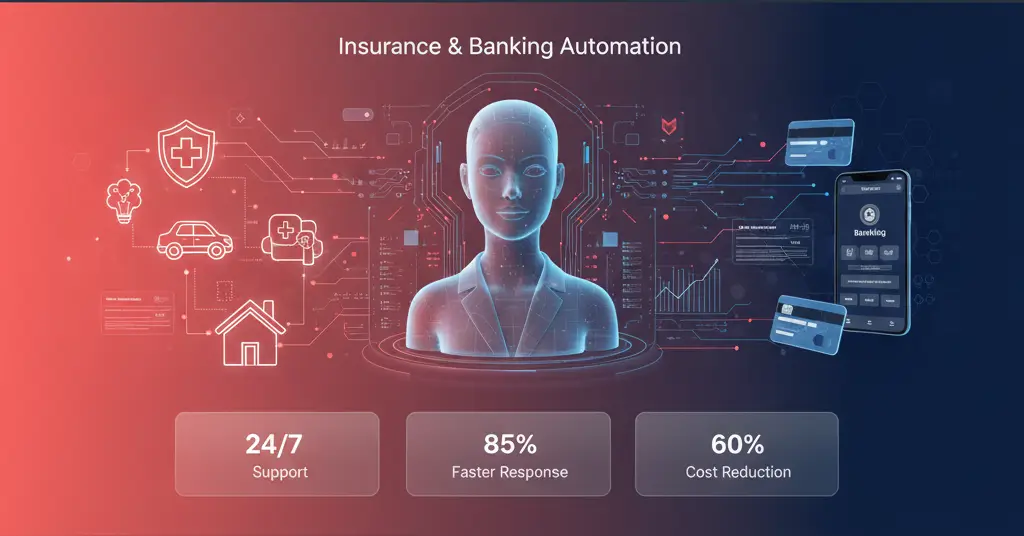
Customer service queues in BFSI are clogged with the same handful of questions: where is my claim, where is my loan, what does my policy actually cover, why did my premium go up. Human agents burn hours on tier-1 enquiries that a well-built Gen AI virtual agent can resolve in seconds, with a citation back to the source document. The number that matters in board reviews — 85% faster average response time on those tier-1 enquiries — is not vendor marketing. It is what our deployments measure on live traffic, and it only shows up when the architecture is right.
The 85% number is real — and the architecture is why
The temptation with Gen AI in banking and insurance is to wrap a generic LLM in a branded chat window and call it a virtual agent. That gets you a demo. It does not get you 85% faster response times, regulator-grade audit trails, or claims handlers who actually use the tool a month after launch.
What does get you there is an agent that reads your real documents, calls your real systems, escalates when it is unsure, and logs everything for the compliance team. The 85% is the headline outcome. The architecture is the whole story.
Across deployments with our AI/ML development practice, the pattern is consistent: when banks and insurers move tier-1 enquiries — claims status, loan application status, balance enquiries, policy wordings, premium calculations — to a correctly-built virtual agent, average handle time on the human queue drops sharply and contact-centre cost per resolution falls with it. The agents who remain spend their time on the complex 20% where their judgement actually matters.
What "correctly-architected" actually means
Five design choices separate a Gen AI virtual agent that survives in production from one that gets quietly switched off after the pilot.
RAG over your real documents
The agent has to ground its answers in your policy wordings, your loan terms, your service agreements, your circulars, your KYC matrices — not in whatever the foundation model absorbed from the open web two years ago. Retrieval-augmented generation is not a feature, it is the floor. Every answer cites the document and the clause it came from, so a customer (or a regulator) can verify it.
Hybrid retrieval
Pure vector search is fashionable and, on enterprise BFSI corpora, it underperforms a hybrid of keyword and semantic retrieval by roughly 15%. Insurance and banking documents are full of exact identifiers — policy numbers, IFSC codes, product codes, IRDAI section references — where keyword precision matters. Hybrid retrieval handles both the exact-match cases and the natural-language reformulations.
Tool use, not chat-in-front-of-a-database
A virtual agent that can only read documents is a glorified FAQ. A virtual agent that can call your core banking system, your policy administration system, your claims platform, your CRM — that is operationally useful. When a customer asks "where is my loan," the agent should authenticate the user, hit the loan management API, return the live status, and offer the next action. Our agents are built as tool-using systems from day one, with tight integration into the platforms we already implement under our BFSI solutions practice.
Confidence-scored handoffs
The agent should escalate to a human when it is uncertain, not after it has hallucinated an answer and a customer has complained. Every response carries a confidence score; below threshold, the conversation is handed to a human with the full context already loaded. This is the single most important design choice for regulator comfort, and it is non-negotiable in our BFSI builds.
Audit trail
Every conversation, every tool call, every retrieved source, every model decision is logged in a form that can be reviewed by an internal auditor or a regulator without forensic work. For Indian banks dealing with the RBI, for African insurers under their national authority, for UK firms answering to the FCA — this is the difference between a deployable system and a compliance liability.
Where Gen AI virtual agents earn their keep in BFSI
The deployments where the 85% number shows up have a few things in common. They target high-volume, repetitive enquiries with clear ground truth in existing documents and systems. They do not try to replace human judgement in complex underwriting or claims adjudication on day one.
The strongest use cases we see across our insurance solutions and banking solutions portfolios:
- Claims first notice of loss and status enquiries. Customers can lodge a claim through the virtual agent, upload documents, and check progress without ever queuing for a human. The agent works alongside the claims management system to keep the workflow auditable.
- Loan application status and disbursement queries. The agent reads from the loan management system and returns the live state — pending document, under review, sanctioned, disbursed — with the next required action surfaced.
- Policy and account-level questions answered from primary documents. "What does my policy cover for hospitalisation?" gets a cited answer pulled from the actual wordings, not a paraphrase.
- Internal copilots for underwriters and claims handlers. The same architecture turned inward: an underwriter asks "what is our appetite for fleet motor in this state given the loss ratio last year," and the agent returns a grounded answer from internal guidance documents and the ML pricing and rating engine.
Customer-facing deployments get the headlines. Internal copilots often get the bigger productivity win — a senior claims handler doing the work of two because the agent has front-loaded the document review.
The integration surface most teams underestimate
A virtual agent that cannot reach your systems of record is a demo. The hard engineering is not the LLM call — it is the secure, auditable, rate-limited integration with the core banking platform, the PAS, the claims engine, the CRM, the document store, and the IAM layer.
Our BFSI builds typically integrate the agent with a policy administration system on the insurance side and a core banking platform on the banking side, with digital channels as the front-end and the agent operating across web, mobile, WhatsApp and voice. The integration work is where most internal Gen AI projects stall, because it requires the domain knowledge of the underlying platforms, not just prompt engineering. That is the gap we close.
Guardrails the regulator will ask about
Before any BFSI Gen AI deployment goes live, a regulator or internal compliance team will want concrete answers to a short list of questions. They do not want a presentation; they want a control description.
- Bias and fairness testing. Has the agent been tested for differential outcomes across protected categories on the use cases it handles?
- Explainability. When the agent gives an answer or makes a recommendation, can a human reconstruct why? Are sources cited inline?
- PII handling. How is customer data masked in prompts, in logs, in retrieval indices? Where is it stored and for how long?
- Hallucination controls. What is the fallback when retrieval returns nothing relevant? Does the agent ever invent? How is that measured?
- Human-in-the-loop. What triggers handoff? Who sees the conversation history when it lands?
- Model lifecycle. What happens when the underlying foundation model is updated by the provider? How is regression caught before customers see it?
Bias testing, explainability, PII controls and audit trails come standard in every BFSI build from our AI/ML expertise practice — not as an add-on workstream, but baked into the architecture from sprint one.
What an honest 90-day rollout looks like
The fastest path to a deployable Gen AI virtual agent in BFSI runs in three phases, and the schedule below is what we actually deliver — not aspirational.
The first 30 days are discovery and grounding. We map the top enquiry types by volume and handle time, identify which documents and systems answer them, and stand up the RAG layer over a clean corpus. We do not skip document hygiene; bad source material poisons every downstream answer.
Days 30 to 60 are the build and internal pilot. The agent is wired into the systems of record, the confidence-scoring and handoff layer is tuned against real conversations, and the audit logging is plumbed into the compliance team's existing review tooling. The pilot runs internally with claims handlers or branch staff before any customer sees it.
Days 60 to 90 are controlled customer rollout, channel by channel, with daily quality reviews and weekly accuracy benchmarks. By the end of the window the headline metrics — response time, deflection rate, CSAT on resolved enquiries, escalation rate, hallucination rate — are stable enough for a board update.
Anything faster than this in BFSI is cutting corners on either the integration or the governance. Both come back to bite.
Where the productivity goes after launch
The first wave of value is the response-time improvement on tier-1 enquiries. The second wave, which shows up around month four, is in the human queue: agents handle fewer but more complex cases, average handle time on the human side actually rises (because the easy work is gone), and CSAT on the cases that need a human goes up because those customers get more attention.
The third wave is internal. Once underwriters, claims handlers and relationship managers start using the same architecture as a copilot — grounded in internal documents, integrated with internal systems — onboarding time for new joiners drops, and institutional knowledge that used to live in three senior heads becomes queryable. This is where the Gen AI investment compounds.
Build with Redian
A Gen AI virtual agent in BFSI is not a chatbot project. It is a domain-grounded, system-integrated, regulator-ready piece of operational infrastructure, and it should be built by a team that understands the underlying banking and insurance platforms as well as the model layer. Start with an AI/ML consulting engagement to scope the use cases and the controls before any code is written, or talk to us through /contact about a 90-day deployment on your highest-volume enquiry types.
Stay current with our insights
One monthly email. Banking, insurance, AI/ML and CRM field notes. No spam.
We respect your privacy. Read our Privacy Policy.
Keep reading
More from AI/ML

AI/ML
Enterprise AI/ML strategy and consulting for BFSI
How BFSI and energy enterprises should approach AI/ML strategy in 2026 — use-case prioritisation, MLOps readiness and ROI math before any code is written.
20 Feb 2026

AI/ML
AI/ML model development for enterprise — production, not demos
How to build AI/ML models that survive contact with production — MLOps, evaluation harnesses, drift monitoring, governance and the discipline that separates real ML from notebooks.
15 Sept 2025
AI/ML
Now enjoy the power of ChatGPT in SuiteCRM with help of ChatGPT Plugin for SuiteCRM by Redian Software
Discover how the ChatGPT Plugin for SuiteCRM revolutionizes customer interactions. Automate email responses, simplify template creation.
04 Dec 2024
Build with Redian
Have a similar build in mind?
We've shipped ai/ml systems for banks, insurers, brokers, MFIs, SACCOs and enterprises across the USA, UK, Africa, UAE and India. Book a 30-min call with a senior engineer — no pitch deck, just a sharp first read on your initiative.
- CMMI Level 3 Appraised · ISO Certified delivery
- 1 business day response · NDA on request
- Senior engineers, not sales — first call